


The Museu Nacional d’Art de Catalunya is located in the Palau Nacional of Montjuïc, constructed for the International Exposition of 1929. In 1934 it opened its doors as the Museu d’Art de Catalunya, bringing together the medieval collection. Subsequently,

Modern Barcelona was born with the Eixample, a district stretching from the Plaça d’Espanya almost as far as the river Besòs. Its continuous grid layout connected the old town (the present-day district of Ciutat Vella) with the other towns and …

The home of the athletes during the 1992 Barcelona Olympic Games is a symbol of the regeneration of the city’s urban coastline and industrial land. The Olympic Village was

The air shuttle that binds the port with Miramar, on the slopes of Montjuic , was devised in 1926 by Carles Buigas, with Ramon Road and Josep M. Roda as collaborators in order to connect the 1929 exhibition with its …


The Torre Glòries, formerly known as Torre Agbar (Catalan pronunciation: [ˈtorə əɡˈbar]), is a 38-story skyscraper/tower located between Avinguda Diagonal and Carrer Badajoz, near Plaça de les Glòries Catalanes, which marks the gateway to the new technological district of Barcelona, …
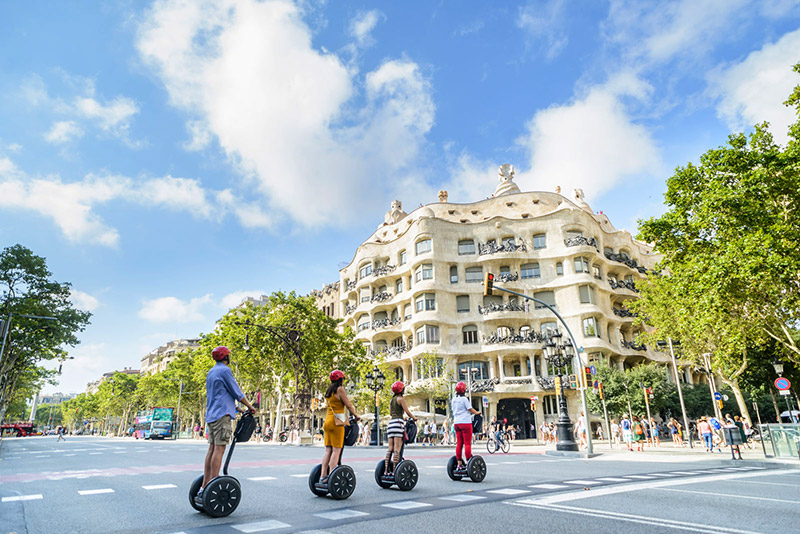
Casa Milà, popularly known as La Pedrera or “The stone quarry”, a reference to its unconventional rough-hewn appearance, is a modernist building in Barcelona, Catalonia, Spain. It was the last private residence designed by architect Antoni Gaudí and was built …
